


Note: Every autistic person’s experience is different. This is my experience with my daughter and she read and approved of this before I posted it.
Nothing could prepare me for the unplanned beauty and fear of having an adult child diagnosed with autism.
My daughter, Isabel, and I are out with friends. She is 17 and, unknown to us, a pandemic is barreling toward us from across the ocean. We’re having fun. She’s been accepted to several colleges and I’m looking forward to having an empty nest because society has taught me that’s the true measure of successful parenting.
Isabel and I are best friends. Gilmore Girls with double the age difference. People find that either endearing or weird. We don’t care.
A friend shares some exciting news. Isabel says she is excited for them but her facial expressions don’t match the words she is saying. No one notices except me. I’ve learned to pick up the small nuances.
On the drive home that night she’s exhausted beyond measure. I’m happy and jittery because I had so much fun. I could have stayed hours longer. She says she feels like she just ran a marathon. She puts on her headphones, leans back in her seat and closes her eyes.
“Rest,” I say, knowing this calms her. “When we get home you can go into your room and curl up, alone.”
I quietly, once again, worry about her stamina. Something is wrong, I’m just not sure what it is. Soon she would be diagnosed with anxiety and depression, which was stunning.
She was always such a happy kid. Always.
Just months later — after she suspected for years and I dismissed it — she was diagnosed with autism.
Public schools had not caught it. Medical professionals had not caught it. I had not caught it. It was Isabel — with relentless drive and research — that figured out what was going on and asked me to have her tested after her psychologist, unprompted, told her, “You may have autism.”
“But,” people say to her, “I can’t even tell!”
Or, to me: “No one will ever know! She’s doing such great things in the world.”
No one looks autistic. I want everyone to know this.
Many autistic people have “special interests.” Isabel is one of them and it makes my head hurt but I love her more through every one of them. She becomes hyperfixated on things and that’s all she will talk about, think about or do until it runs its course. Sometimes this can mean hours and, more often, days or weeks. This is how she got me to drive her cross-country to Los Angeles one summer to meet a celebrity. This is how she got me to homeschool her. This is how she gets me to do many, many things I’m not in the mood for or simply not interested in.
It forces me out of my comfort zone.
She saved herself. Her hyperfixation found the true root of her depression — autism.
I was not prepared me for the second guessing. The rearranging of an entire life. The wondering, “What would I have done differently?
The main question that nags at me about various scenes from her childhood: “How much of this was her and how much of it was autism?”
The answer, of course, is both. It’s all her and autism is part of her.
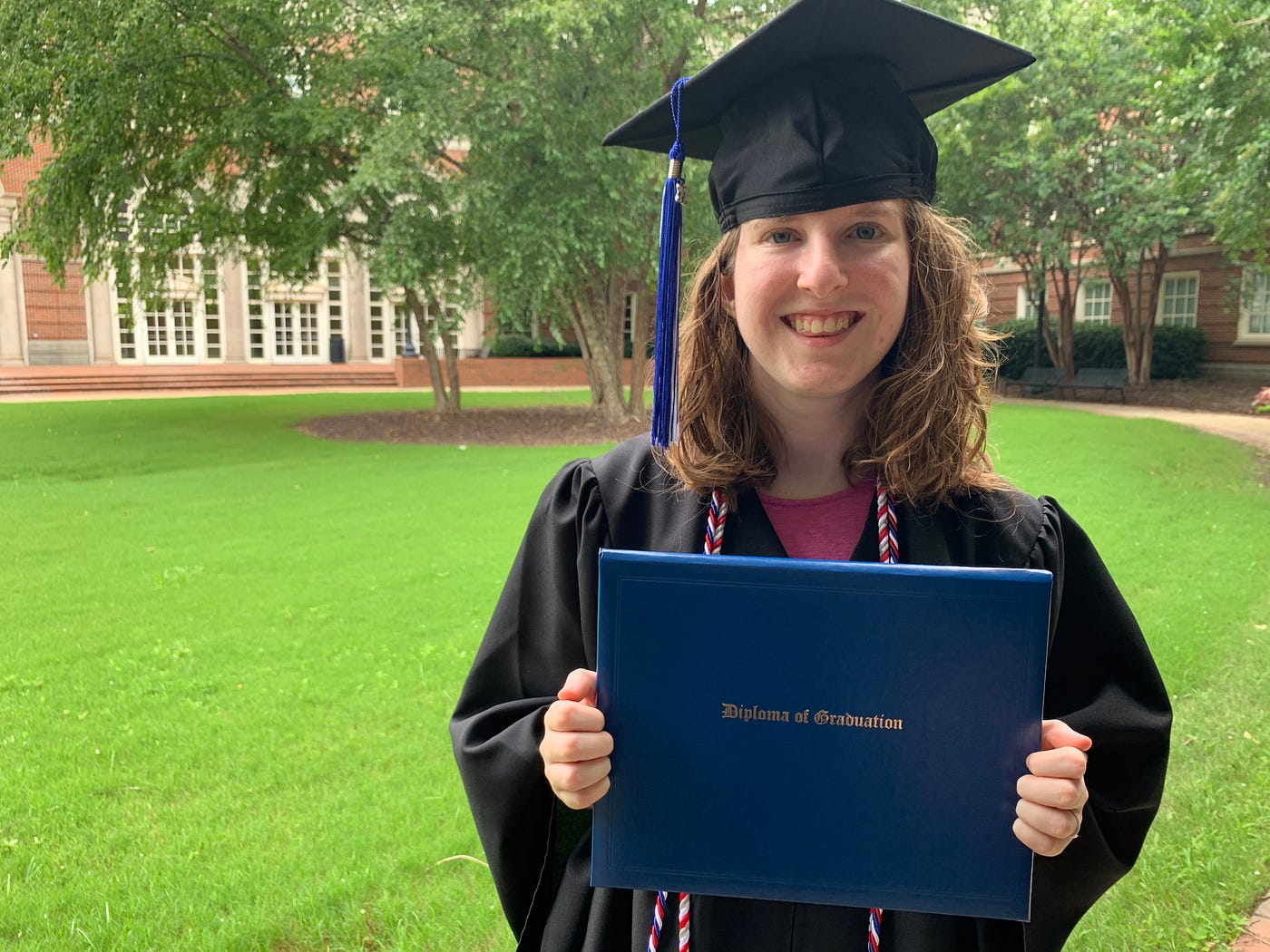
She was diagnosed at 18, a few months into the pandemic. The pandemic — in all of its convoluted wisdom — gave me time to think and reflect on raising what I now know as an autistic child. It gave me boundless time to pick apart every decision I have made in the last 19 years.
Unlike my Type 1 diabetes, autism isn’t a piece of her or something she can separate from herself. It’s not a disease. It’s a developmental disorder. It is her brain. It’s her personality. It’s everything I love about her and everything that makes me unhinged. To say autism is a “problem” would be a slap in the face to her. To want to take it away from her would be me telling her that her personality was flawed.
Autism makes her feel alone and isolated. That makes me sad.
The psychiatrist tells us that, while she may be a junior in college at 18, developmentally she is about 15 going on 16.
Everything — and I mean everything — falls into place at that moment, like someone has retroactively given me the Magical Keys to Parenting.
Autism often comes with depression because, like her, many autistic people feel misunderstood, alone and constantly have to mask the behavior they actually feel. They struggle to act “normal,” or neurotypical.
Any of us would be depressed not being ourselves all day. My heart aches for her.
The thing I am most aware of in this new, uncharted autistic adventure, is an unseen force between me and Isabel.
I know her better than anyone else but there is a part of her I will never know.
Countless times a day she will alter her behavior to do what she knows what neurotypical people do. She understands the “correct” way to act. Sometimes I have to explain to her what’s not OK to say or do because she says and thinks exactly what she feels, at all times, without fail. It is a superpower and a curse. I never publicly stop her from being herself, but later, quietly at home, I might explain how she hurt someone’s feelings or asked a question that was too personal, like the time she asked one of my friends, “So, are you going to cheat on your wife?” (He was.)
A few daily scenes:
- Her peripheral friends were eager to drive at 16. Not only did she not want to learn, she adamantly positioned against it. I now know that her autism gives her massive sensory overload so driving could be dangerous for her. I’m glad I never forced her. She will learn soon, with the help of a professional trained to help people with sensory issues learn to drive.
- We would take cross-country trips every year; long, winding road trips through America. She would never have to stop to use the bathroom. Never. I took this as the weirdest kind of teenage rebellion. I now know that people with autism have interoception, the inability to detect and attend to internal bodily sensations. Many people with autism, especially women, will set alarms to remind them to go to the bathroom, eat (she also never knows when she is hungry) or do daily tasks.
- We’re at an indoor shopping mall with some friends. Afterward she would come home and lie in her room, alone sometimes in dim or no light. “Poor kid,” I thought. She’s an only child and being around that many people is too much for her. I now know her sensory issues make malls a living hell.
- She’s always been a “loner” and “sensitive.” She’s never had a best friend and — as far back as pre-school — teachers noted her affinity for sitting and watching an activity before she tried it, from finger painting to playing with puppets. She does not jump in. She thoughtfully considers every move. This is a gift.
Now I know these seemingly small things were signs of autism. 18 years of them piled up at my feet and I still did not know to connect the dots. I found myself often defending her seemingly odd decisions to well-intentioned friends.
I constantly felt like my parenting was under attack. That’s nothing compared to what she felt — like her entire being was under attack.
Autistic girls are often misdiagnosed and are widely underdiagnosed. Historically, like everything else, studies about autism have been about boys and men. 18 is actually an early age for a woman to be diagnosed because of the stereotype of “rambunctious boys,” whose autism is often caught easily in school.
Girls are usually considered “odd,” “quirky” and “quiet,” all adjectives her teachers — and I — have used to describe Isabel. Media portrayals of autistic people are always those of boys and men — never girls or women — who are either incapable and incompetent or have savant-like gifts. Nothing in between.
The statistics are frightening. 70% of autistic adults don’t think they have proper resources. The unemployment rate is 85%. People with autism comprise 12% of the homeless population. Girls are three times more likely to experience sexual violence
Three times more likely.
As a parent, these statistics make me want to revert to her baby days, when I could follow her around as she crawled. I watched her every move to make sure she didn’t bump into a sharp edge.
My “baby” is three times more likely to be sexually assaulted because social cues elude her.
Isabel started homeschooling in sixth grade because of wild discrepancies in her abilities across subjects and entered college classes at 14. Now, as an 18-year-old college senior, I know homeschooling is common for autistic children.
She has educated me. She has forced me to confront my own misconceptions about autism. I have traded the words “high functioning” and low functioning” for the preferred “high support needs” and, in her case “low support needs” (because who wants to be labeled “low functioning”?). I also know that the easily-recognized autism puzzle piece logo is offensive to many people with autism.
I have stopped using the term Asperger’s Syndrome. Hans Asperger was a Nazi sympathizer that used autistic people as study subjects. He made sure the people that were “not smart” were disposed of and studied the smarter ones.
Isabel has taught me that she loves being autistic and finds it to be a gift. She would not want to be “cured “or “changed” even if she could. I’ve learned that looking at autism as a disability is incorrect. It’s actually a wonder and a marvel.
I tune into how autistic people think and feel by following #ActuallyAutistic on Twitter and Instagram. I recognize my daughter in many faces and explanations I see there and it’s wonderful. I have learned that parents of autistic children often speak for them. I have tried to be very careful here to represent only my point of view, not hers.
Autism awareness and acceptance month begins April 1 and it’s my first month being truly aware, and accepting.
I am aware that my nest may never be empty. As a parent, that’s the best gift autism has given me. More time with the person I love the most.